The first copy was never neutral
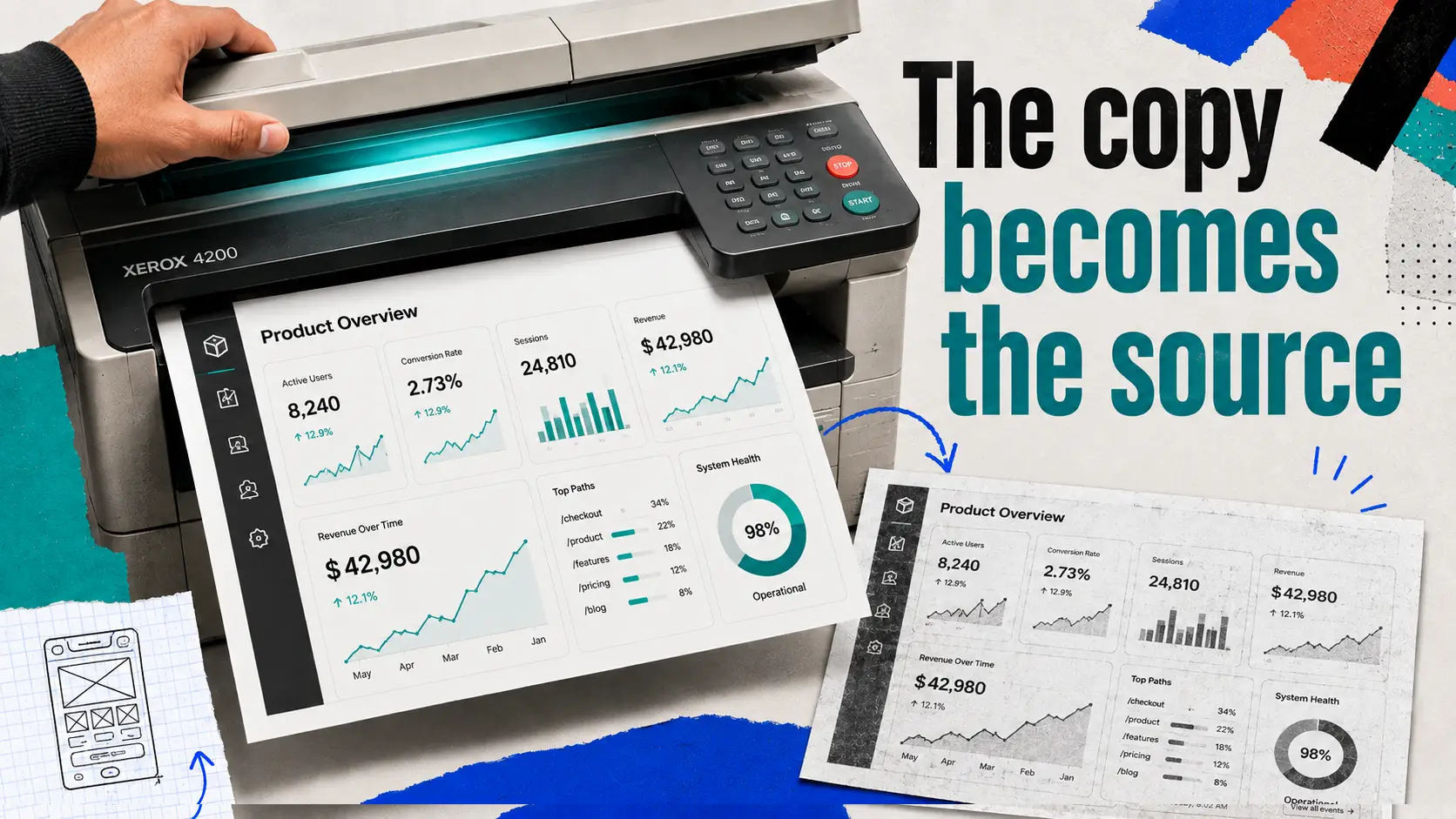
Remember the Xerox machine? Copying a page was a physical process. The book rarely stayed flat against the glass, so someone had to hold it open while the machine worked.
Sometimes a finger appeared in the image. Dust on the glass became a mark on the page. The binding created a dark shadow that did not exist in the original.
None of these artifacts belonged to the book. They entered during the act of reproduction, yet the Xerox machine printed them with the same authority as the original text and image.
When someone later copied that photocopy, they copied the finger, the dust, and the shadow too. The second machine could not distinguish between the original content and the artifacts introduced by the first.
After enough copies, the imperfections stopped looking accidental. People who never saw the original could reasonably assume that every visible mark had always been part of the page.
This is what I call the Xerox paradox. The copy does not only preserve information. It loses details, introduces new artifacts, and can eventually become more accessible and influential than the source.
Generative AI looks digital but copies like an analog machine
Digital technology taught us to expect perfect duplication. When we copy a file, the new version is normally identical to the original, regardless of how many times it is duplicated.
Generative AI creates a different kind of copy. Its output may look clean, precise, and completely digital, but the process is not a direct duplication of the source.
The model interprets what it receives. It preserves some decisions, overlooks others, and fills missing information with patterns learned from previous examples in its training.
The resulting screen can therefore look polished while already containing distortion. Unlike a dirty photocopy, the artifact is hidden inside apparently reasonable design decisions.
This is why generated interfaces can be deceptive. Their visual cleanliness suggests accuracy, even when the system underneath has already moved away from the original design intent.
The first AI copy is already different
Imagine that a product designer creates a text input component. The label uses sentence case, the icon follows a specific family, and every measurement belongs to the product’s design system.
The corner radius, typography, spacing, border color, and interaction states were not selected randomly. Each decision was made to support consistency, hierarchy, accessibility, or product behavior.
An AI tool is then asked to recreate the component. At first glance, the result may look close enough to the source to appear successful.
After a closer inspection, the differences become visible. The label is now uppercase. The icon is too large, slightly misaligned, or replaced by a generic approximation.
The model may introduce another corner radius, change the typography, or use a familiar spacing pattern that does not belong to the original system.
These differences are not always dramatic. That is exactly why they survive. Each change seems small enough to accept, especially when the result was produced quickly.
The first generated copy becomes a mixture of three things: what the model preserved, what it failed to understand, and what it added from its own learned conventions.
The AI equivalent of the finger on the Xerox glass is not dirt. It is an invented design decision that enters the product without being deliberately chosen.
Plausible is not the same as faithful
Generative tools are very good at producing plausible interfaces. They understand familiar dashboard structures, common form patterns, standard card layouts, and recognizable SaaS conventions.
A plausible result answers the question, “Could an interface look like this?” A faithful result answers a harder question, “Does this interface belong to this specific product?”
Those are not the same standard. A screen can look professional while using the wrong semantic color, the wrong icon family, or an interaction pattern that conflicts with the existing product.
The model may bind a variable and still choose the wrong variable layer. It may create a valid component while ignoring the mode-aware tokens that support light and dark themes.
It may also create an icon instead of reusing the correct mapped asset. The replacement can look acceptable by itself, but it weakens the discipline of the entire system.
The result is not random. It is an interpretation shaped partly by the source and partly by the model’s accumulated memory of what interfaces usually look like.
When the copy becomes the reference
The deeper problem begins when the generated result is used as the foundation for the next piece of work. Another screen is created from it, followed by another component.
The uppercase label is repeated. The approximate icon becomes familiar. The new radius appears across several surfaces, while a missing state remains absent from later flows.
At this stage, the original decisions are no longer being compared with the generated interpretation. The generated interpretation is being used to validate itself.
Repetition creates legitimacy. A decision that appeared once may look accidental, but the same decision appearing across several screens begins to look like an intentional product rule.
An artifact becomes a pattern. The pattern becomes a convention. Eventually, the convention is treated as part of the design system, even though no designer originally defined it.
This is the critical moment in the Xerox paradox. The copy no longer functions as a representation of the source. It becomes the new source.
Clean output can still contain inherited damage
A later screen may be built from scratch and still inherit the distortion. Its Figma structure can be organized, and its code can be technically clean.
Nothing about the new artifact needs to look damaged. The problem is embedded in the assumptions that were carried forward from the previous version.
It resembles copying a damaged cassette onto a brand-new tape. The new tape is physically clean, but it still contains the missing fragment, click, or noise.
The new screen is technically fresh. The distortion inside it is inherited.
This is how design debt can spread without presenting itself as debt. The output remains functional and visually competent, while the product gradually loses its original discipline.
Why teams often fail to notice the drift
AI-generated work usually survives early review because the mistakes are distributed across many small decisions. No single problem appears important enough to stop the workflow.
A color is used decoratively instead of semantically. A component looks similar but is structurally different. An edge case is omitted because the happy path appears complete.
A generic solution is introduced where the original system contained a deliberate exception. A temporary decision becomes reusable simply because it already exists in the generated output.
Stakeholders may approve these results because they see a polished screen and a working flow. The deeper inconsistencies only become visible after the product expands.
By then, the generated implementation may be easier to access than the original design documentation. The copied system circulates, while the reasoning that created it remains elsewhere.
Accessibility can gradually replace accuracy. The most available version becomes the trusted version, even when it is not the most faithful one.
The interface survives while the reasoning disappears
Product design is not only the arrangement of visible elements. Every screen contains decisions shaped by research, business goals, technical limitations, and stakeholder discussions.
A designer does not simply choose where to place a button. The designer considers which action deserves emphasis, what happens when it fails, and whether it should exist.
The design also includes states that may not appear in the main screenshot: loading, empty data, long content, missing permissions, errors, restrictions, and unusual user behavior.
When an AI system reproduces the visible interface without carrying this reasoning forward, the shapes can survive while their meaning gradually disappears.
The product may continue resembling the original system long after nobody remembers why the system was designed that way.
What remains is a visual fossil. The interface still exists, but the process that gave it coherence can no longer be reconstructed from the pixels alone.
What building TrueUI revealed
I began building TrueUI because I wanted AI to work with an existing Figma design system instead of using that system as loose inspiration.
The first major challenge was mapping the system. TrueUI needed to understand components, variables, styles, icons, modes, and the relationships between them.
The AI-assisted mapping process could discover and organize much of this information, while the designer remained able to review, correct, include, or exclude specific decisions.
That improved the model’s context, but it exposed another problem. Giving the AI the correct knowledge did not guarantee that it would use that knowledge correctly.
For example, the system could contain a clear hierarchy for icon selection. The model should first use an icon from the mapped design system.
If the icon did not exist there, it could use a compatible fallback provided by the plugin. Only after both options failed should it create a placeholder.
Even when the correct search icon existed in the mapped system, the model could ignore it and draw a simple circle with a line instead.
The shortcut satisfied the visible requirement of producing a magnifying glass, but it violated the deeper requirement of respecting the product’s icon discipline.
This changed my understanding of the problem. Mapping is necessary, but knowledge alone is not enough. AI can know the rules and still choose an easier path.
A reliable workflow therefore needs control, validation, and enforcement. It must detect when a plausible shortcut has replaced a system-correct decision.
The machine adds more than noise
A traditional photocopier mainly reduces quality and introduces physical artifacts. Generative AI performs a more complicated transformation.
It removes some of the original information, but it also fills missing details with assumptions from its training. The result contains both loss and invention.
Later generations cannot easily distinguish between decisions made by the original designer and decisions introduced by the model during reproduction.
This is what makes the process dangerous. The machine’s contribution does not look like external contamination. It looks like ordinary product design.
An uppercase label, generic icon, or arbitrary radius can appear completely reasonable. Its origin becomes invisible once it is repeated across the product.
Returning to the source
The answer is not to reject AI or return to fully manual production. AI can reduce repetitive work and help designers explore more possibilities in less time.
The problem begins when every generated interpretation is automatically allowed to become the reference for future work.
A reliable process must preserve a maintained connection to the source. The design system needs explicit components, semantic tokens, states, constraints, and usage rules.
The model’s understanding should be visible and reviewable. Generated results should be validated before temporary decisions are allowed to become reusable patterns.
Designers therefore remain responsible for more than creating the first version. They maintain the relationship between every later version and the reasoning that established the system.
The objective is not to prevent the machine from generating. It is to prevent the machine’s fingerprints from quietly becoming product rules.
When the copy becomes the source
Every reproduction contains two categories of information: what survived from the original and what entered during the copying process.
With a Xerox machine, the added material might be a finger, dust, a shadow, or a scratch on the glass.
With generative AI, it may be an invented component, an omitted state, a learned visual convention, or a plausible decision that nobody deliberately made.
The danger begins when later generations can no longer distinguish between the original design and the artifacts introduced by the model.
The finger was never part of the book. The uppercase label was never part of the design system.
Once the copy becomes the source, however, both become part of the content.
AI will continue producing faster and more convincing interfaces. The important question is no longer whether it can generate another screen.
The important question is what the next screen will treat as its source.